Psilocybe Hoogshagenii
Genus: Psilocybe
Species: Psilocybe hoogshagenii R. Heim
Section (commonly placed): Mexicanae
Eponym: Named in honor of Searle Hoogshagen
Primary Relevance: Taxonomy, morphology, ethnomycology, species identity
Hoogshagenii Overview
Psilocybe hoogshagenii is a distinctive neotropical species recognized for its small stature, sharply papillate cap, and long-standing importance in the study of Mexican Psilocybe. Though modest in size, it holds outsized significance in mycology due to its early documentation, unique morphology, and association with traditional use in Mesoamerica.
This profile documents P. hoogshagenii as a species-level entity within the Genetic Vault, emphasizing observable traits, ecological context, and taxonomic relevance rather than folklore or modern reinterpretation.
A look into what is Psilocybe Hoogshagenii
Taxonomic Background
The species was formally described by Roger Heim and named in honor of Searle Hoogshagen, an American anthropologist who contributed to early ethnomycological research in Mexico. Psilocybe hoogshagenii has long been discussed alongside other Mexican Psilocybe species, particularly those now grouped within or associated with section Mexicanae.
Historical confusion has occasionally arisen due to superficial similarities with related taxa, leading to misapplication of names in early literature. Subsequent clarification through combined macroscopic, microscopic, and ecological study has reinforced P. hoogshagenii as a distinct species.
Natural Range & Ecology
Psilocybe hoogshagenii is most often reported from southern Mexico, with additional observations across parts of Central and South America. It is typically encountered in subtropical environments, where seasonal moisture and terrain play a defining role.
Field observations frequently place this species along water runoff channels, hillside slopes, and pasture-adjacent areas, often in soils enriched by organic material. Its recurring presence in disturbed landscapes suggests an ecological adaptation to transitional or edge habitats rather than dense forest interiors.
Morphology
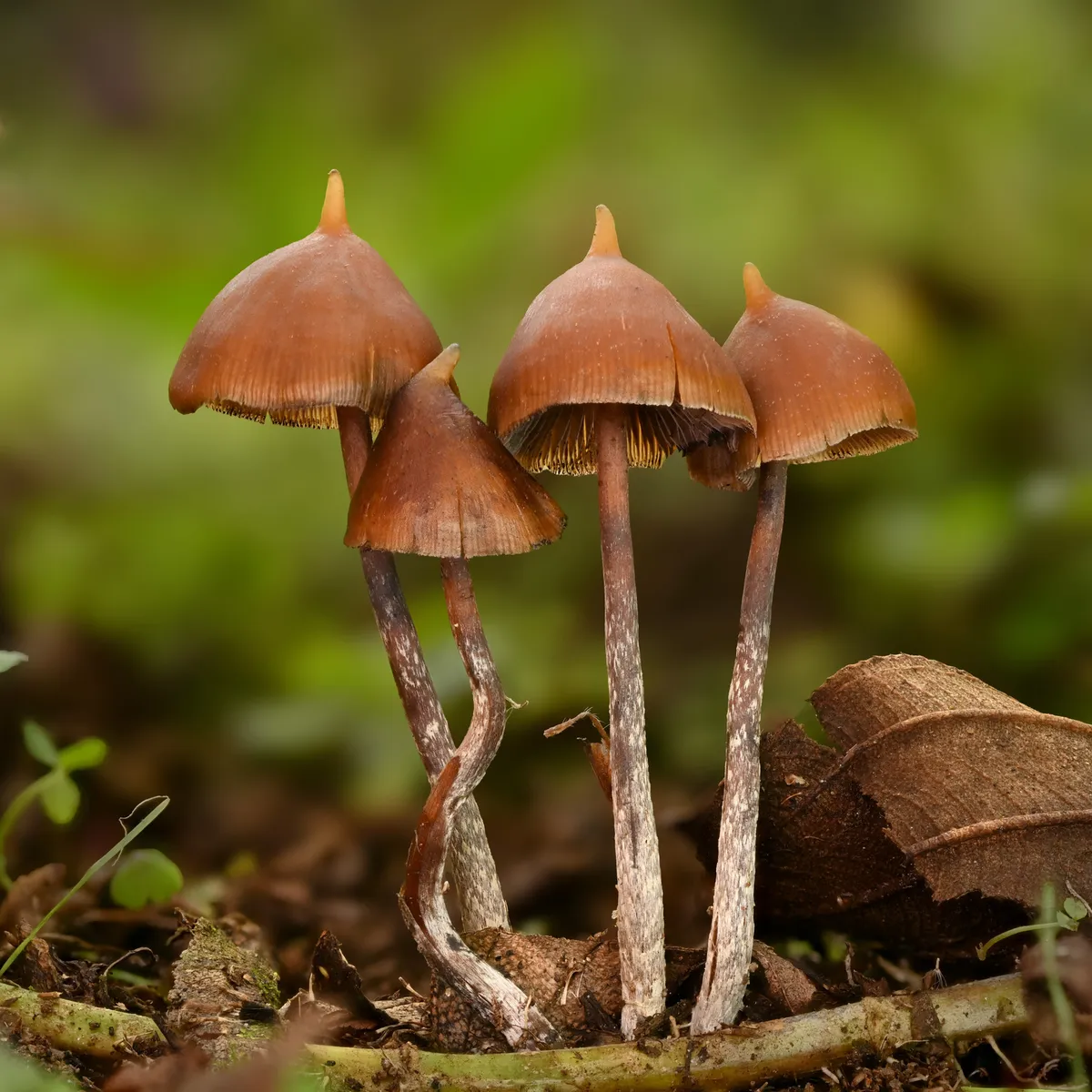
Despite its small size, P. hoogshagenii is immediately recognizable when encountered in context:
Cap: Small, conical to bell-shaped, strongly hygrophanous
Papilla: A prominent, sharply defined papilla is characteristic of the species
Coloration: Darker when moist, fading as it dries
Bruising Response: Blue discoloration upon handling or damage
Overall Form: Slender, delicate, and sharply profiled
A named variety, P. hoogshagenii var. convexa, has been described as lacking the pronounced papilla, illustrating the importance of evaluating multiple traits together.
Microscopy Notes
Microscopic examination has played a central role in distinguishing Psilocybe hoogshagenii from closely related species. Spores are commonly described as rhomboid in face view and more ellipsoid in profile, with thick walls and a visible germ pore. Additional microscopic features, including cystidia characteristics, contribute to species confirmation.
As with many Psilocybe taxa, microscopy serves as a confirming tool that complements, rather than replaces, macroscopic and ecological observation.
Genetic Context & Species Significance
Psilocybe hoogshagenii occupies an important position within discussions of Mexican Psilocybe diversity. Its recognition helped refine species boundaries and highlighted the limitations of relying on superficial appearance alone for classification.
The species is frequently cited in broader conversations about section Mexicanae, a group that includes several historically and biologically significant taxa. Its continued relevance reflects the value of early documentation combined with modern reassessment.
Ethnomycological Notes
Secondary literature and ethnographic summaries often associate Psilocybe hoogshagenii with traditional ceremonial or divinatory practices in parts of Mexico. While such accounts contribute to the species’ cultural context, they vary in specificity and reliability and are best considered alongside biological evidence rather than as primary identifiers.
Documentation Notes
Reports occasionally suggest the formation of sclerotia in association with P. hoogshagenii. While sclerotia formation is documented at the genus level within Psilocybe, species-specific evidence for hoogshagenii remains limited and is best described as anecdotally reported rather than conclusively documented.
Continued observation, microscopy, and careful record keeping remain essential for clarifying unresolved aspects of this species.